Takayama · Gifu · Japan
Takayama, Japan: the old town, two festivals and the Okuhida mountains in one guide
Takayama, Japan, in one page: Sanmachi old town, morning markets, the UNESCO-listed festival, Okuhida onsen, when to go, how long to stay and how to get in.
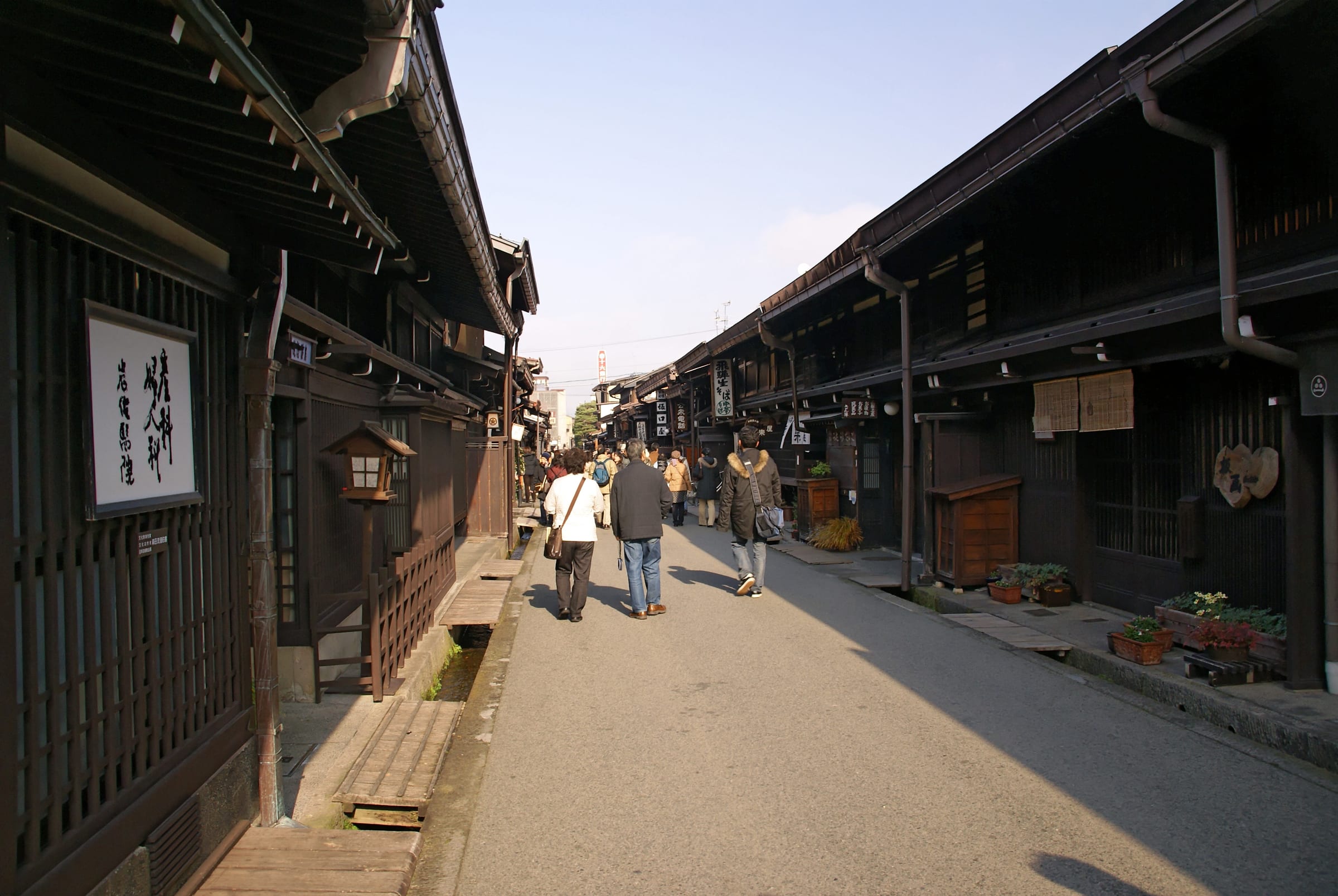
Takayama, Japan, is usually sold as one street of dark wooden merchant houses, and that street alone is worth the trip. But Takayama City is also the largest municipality in Japan by area: 2,177.61 km², about 81 km east to west, from the Sanmachi old town and its two morning markets up to the Okuhida onsen villages and the 2,156 m top station of the Shinhotaka Ropeway. It holds two of Japan’s great float festivals, inscribed by UNESCO in 2016, and counted 978,312 foreign overnight stays in 2025. This page is the short version: why go, when, for how long, and how to get in and around, with every number checked against the city’s own figures and each sight linked to its official page.
Takayama in one minute
Takayama sits in a basin in the Hida region of northern Gifu, 162 km from Nagoya, 88 km from Toyama and 92 km from Matsumoto by road. The Kanamori lords, granted Hida in 1586, began the castle and its town in 1588; in 1692 the shogunate took Hida as its own territory and governed it from Takayama Jinya until 1868, the only such office in Japan whose main buildings still stand. The merchant streets that grew up under both regimes are the old town you walk today. Forest covers about 92% of the city, and the land climbs from 436 m in the Kamitakara district to 3,190 m on Mount Okuhotaka; City Hall itself stands at 573 m, which is why January averages minus 1.2 °C and the city counts 112.5 frost days a year. Around 80,900 people live here, and in 2025 foreign visitors accounted for 42.1% of every night sold in the city.
The old town and the morning markets
Sanmachi is three parallel streets, Kami-Ichinomachi, Kami-Ninomachi and Kami-Sannomachi, lined with two-storey townhouses, sake breweries and shops, about 15 minutes on foot east of the station. The national government selected the 4.4-hectare core as an Important Preservation District for Groups of Traditional Buildings on 3 February 1979, and added the 6.6-hectare Shimo-Ninomachi and Oshinmachi district to the north in 2004, so the old town is larger and quieter than the one crowded block most visitors see. Our street-food guide covers what to eat while you walk.
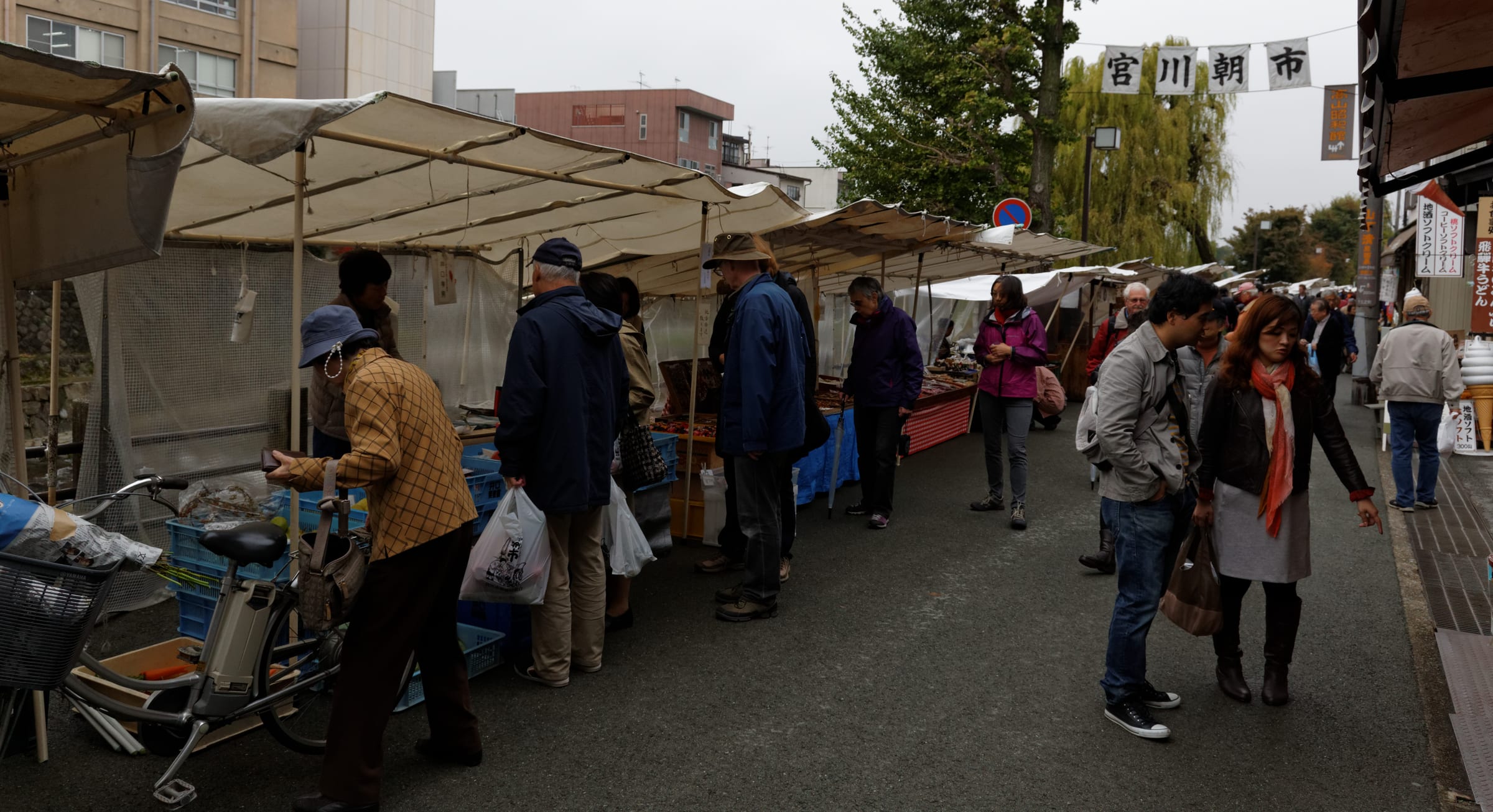
Two morning markets run every day of the year. The Miyagawa Morning Market lines the east bank of the Miyagawa at Shimo-Sannomachi from 7:00 to noon (8:00 from December to March); the stallholders’ cooperative warns that bad weather thins the stalls. The Jinya-mae Morning Market fills the forecourt of Takayama Jinya from 6:00 to noon between April and December and from 7:00 in January to March, with about 25 member farmers selling vegetables, pickles, miso and crafts. It traces its origin to an Edo-period mulberry-leaf market, and both are counted among Japan’s three great morning markets.
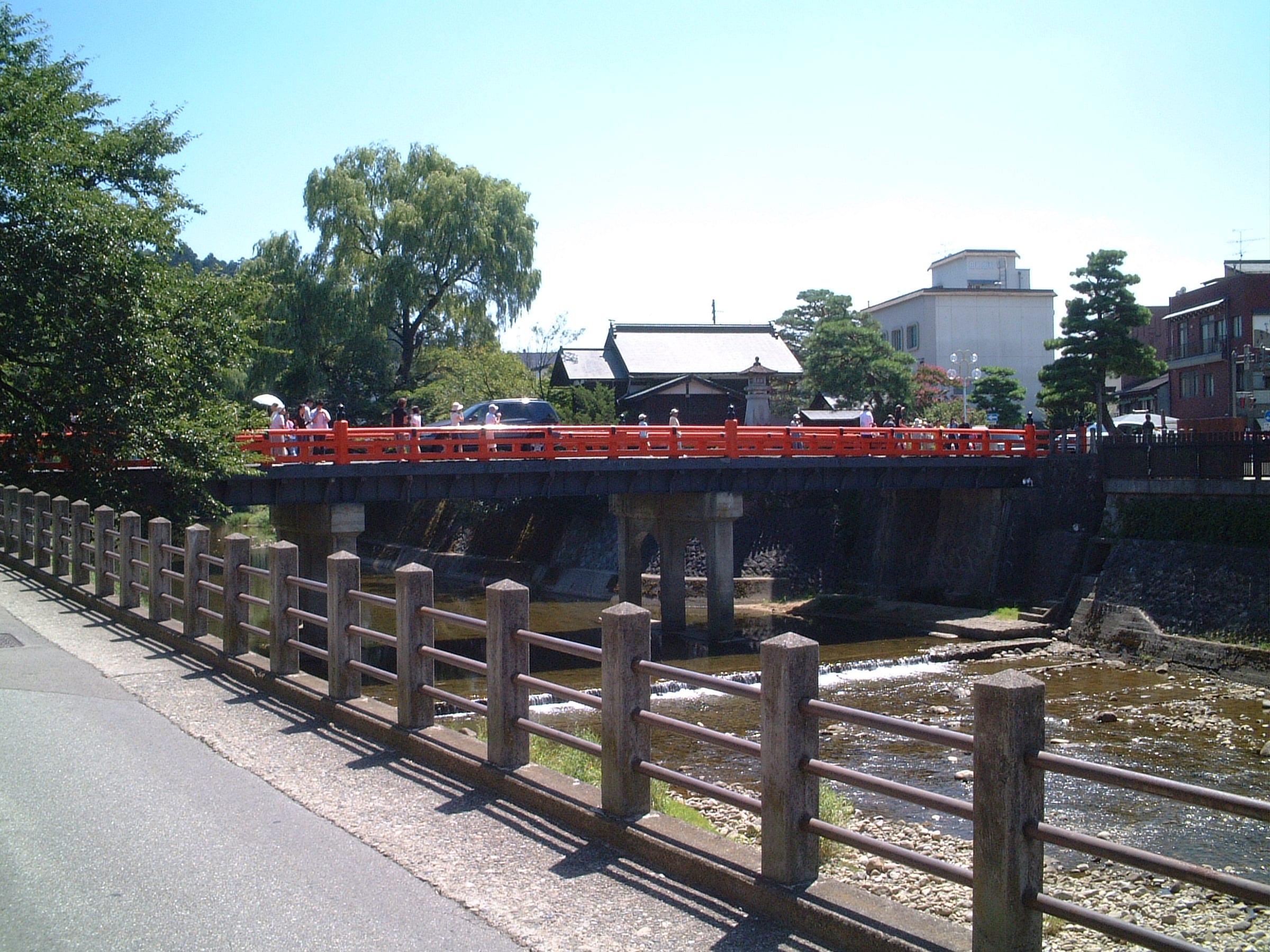
Takayama Jinya, across the red Nakabashi bridge from Sanmachi, opens 8:45 to 17:00 from April to October and 8:45 to 16:30 from November to March (last entry 30 minutes earlier), closed over New Year, and the adult ticket became ¥500 on 1 April 2026. It is a national historic site: the magistrate’s office, residence, storehouses and courtroom of the shogunate’s Hida administration.
For a quieter hour, the Higashiyama Walking Course runs about 3.5 km through the temple district the Kanamori lords laid out on the eastern hills, ending in Shiroyama Park on the site of their castle; the start is 15 minutes from the station.
The Takayama Festival, twice a year
The Takayama Festival is two festivals. The Spring Festival (Sanno Matsuri) is the annual festival of Hie Shrine on 14 and 15 April every year: twelve ornate yatai floats, three of them (Sanbaso, Shakkyotai and Ryujintai) performing karakuri marionette shows, and on the evening of the 14th a night procession with about 100 lanterns on each float. The Autumn Festival (Hachiman Matsuri) belongs to Sakurayama Hachimangu on 9 and 10 October, with eleven floats and an evening parade from 18:00 to about 21:30 on the 9th. The floats were designated Important Tangible Folk Cultural Properties in 1960, the festival itself an Important Intangible Folk Cultural Property in 1979, and on 1 December 2016 UNESCO inscribed the Takayama Festival float events among the 33 Japanese festivals of Yama, Hoko, Yatai. The city’s own count shows April and October as its busiest foreign months, so rooms sell out early; our events calendar carries each year’s dates and programme, and our stay hub explains where to base yourself.
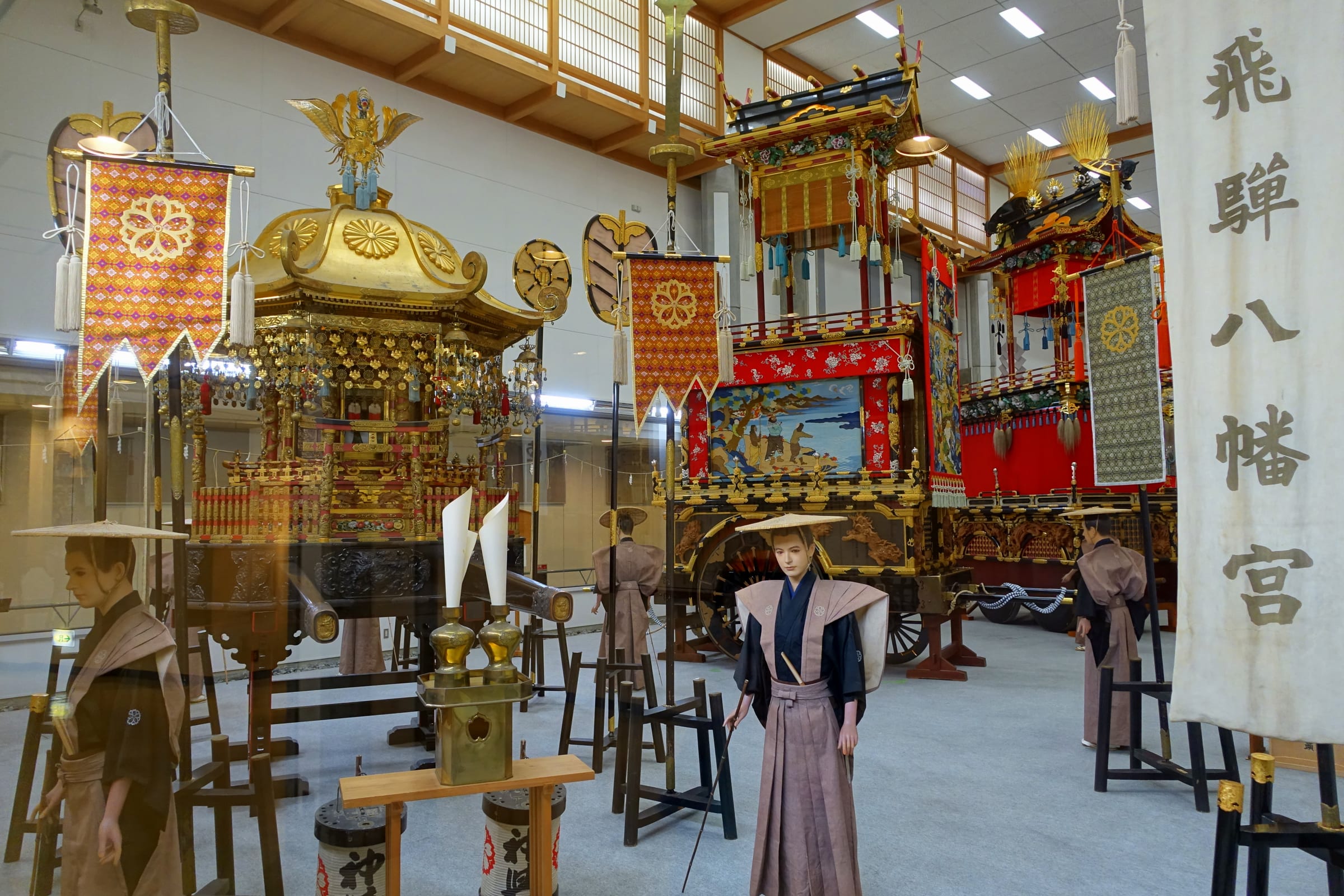
Outside festival week, the Takayama Festival Floats Exhibition Hall (Yatai Kaikan) on the grounds of Sakurayama Hachimangu, open since 1968, shows four of the eleven autumn floats at a time, rotated three times a year. Travel-guide listings give its hours as 9:00 to 17:00 (to 16:30 from December to February) and the adult ticket as ¥1,000; confirm at the shrine before you go.
Beyond the old town: Okuhida and the outer districts
On 1 February 2005 Takayama merged with nine surrounding towns and villages (Nyukawa, Kiyomi, Shokawa, Miya, Kuguno, Asahi, Takane, Kokufu and Kamitakara), which is how a town of old streets became a city that reaches the Northern Alps. The first step out is close: Hida Folk Village (Hida no Sato), open since 1971 on a hillside west of the station, is an open-air museum of relocated Hida farmhouses, including thatched gassho-style houses, open 8:30 to 17:00 every day of the year for ¥700 (¥200 for schoolchildren), nine minutes away on the Sarubobo bus.
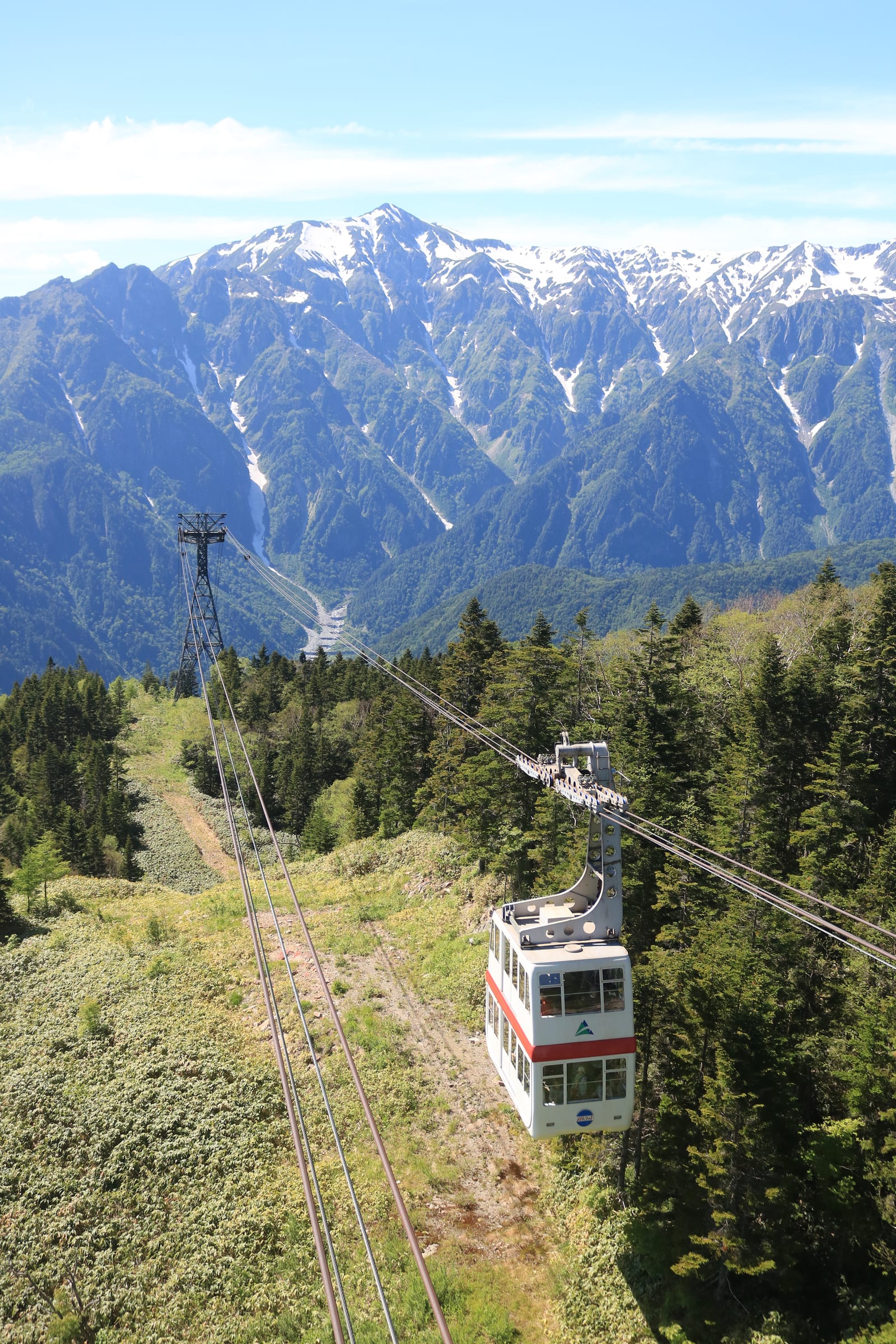
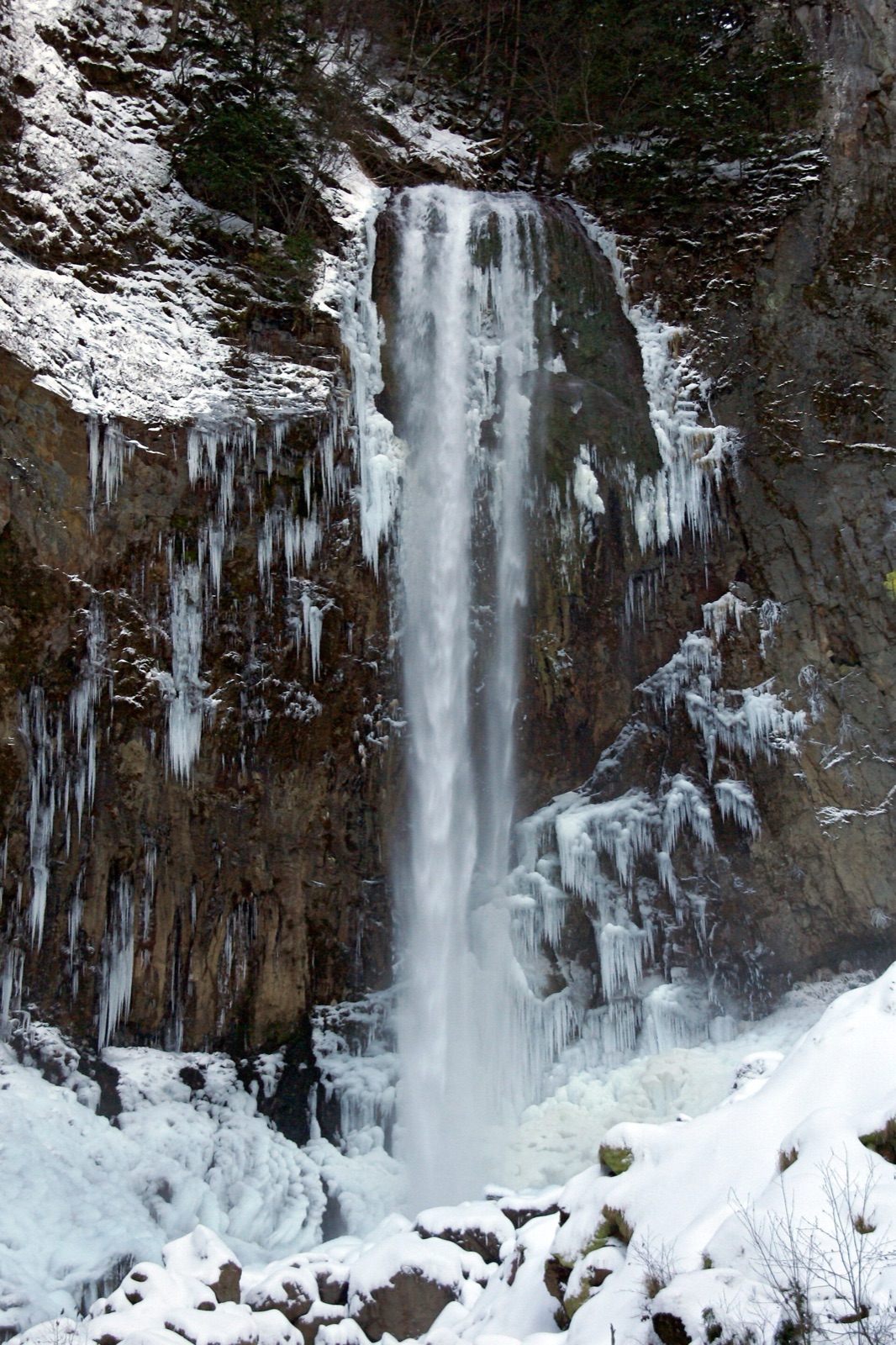
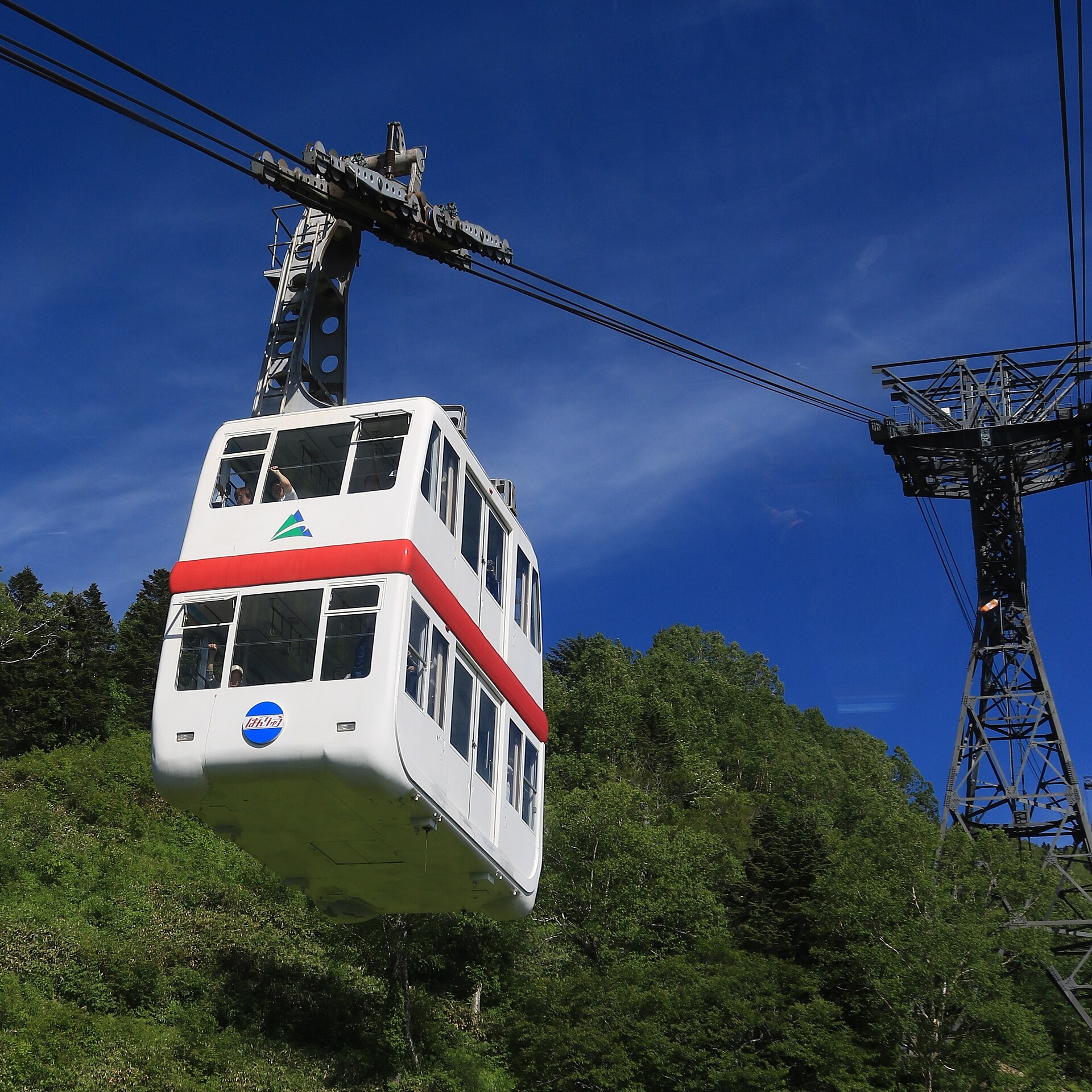
The big step is Okuhida Onsengo, the five hot-spring villages of Hirayu, Fukuji, Shin-Hirayu, Tochio and Shin-Hotaka at 800 to 1,300 m under 3,000 m peaks. The area’s association counts more than 100 springs and about 37,000 litres a minute, the third-largest flow in Japan. The Nohi bus from the terminal beside the station reaches Hirayu in about an hour (¥1,600) and the Shinhotaka Ropeway in about an hour and three quarters (¥2,200). The ropeway’s second stage uses Japan’s only double-decker gondola and tops out at 2,156 m; the adult round trip on both stages is ¥3,800. In winter the 64-metre Hirayu Great Falls freezes and is lit from 19:00 to 21:00 for the ice festival held every year from 15 to 25 February. The Norikura Skyline into the Nyukawa district has been closed to private cars since 2003 and shuts entirely from late October to mid-May, so Norikura and Kamikochi are bus-only trips from Hirayu. Our relax hub covers the baths, the tours hub the guided and chartered ways up, and the getting-around page the timetables and passes.
When to go
The figures are the Japan Meteorological Agency’s 1991 to 2020 normals for Takayama’s own station; the festival dates are fixed by the shrines.
- Winter (December to February)
- Monthly mean: December 1.6 °C, January minus 1.2 °C (lows minus 4.8 °C), February minus 0.6 °C
- What it is like: Snow on the old town; maximum snow depth normals of 26 cm in January and 22 cm in February; mountain passes closed
- What is on: Hirayu Great Falls Ice Festival, 15 to 25 February; the Hida runs reserved-only over New Year
- Spring (March to May)
- Monthly mean: March 3.4 °C, April 9.7 °C, May 15.6 °C
- What it is like: Cherry blossom around the festival; April is the second-busiest month from abroad (107,423 stays, 61% of all nights)
- What is on: Spring Takayama Festival, 14 to 15 April
- Summer (June to August)
- Monthly mean: June 19.7 °C, July 23.5 °C, August 24.4 °C (highs 31.0 °C)
- What it is like: July is the wettest month at 260.9 mm; cooler than the cities, and Okuhida at 1,300 m is cooler still
- What is on: Norikura Skyline and the Shinhotaka Ropeway’s alpine season
- Autumn (September to November)
- Monthly mean: September 20.0 °C, October 13.5 °C, November 7.1 °C
- What it is like: Clear days; October is the city’s busiest foreign month (112,775 stays)
- What is on: Autumn Takayama Festival, 9 to 10 October
How long to stay
One full day is enough for the old town, a morning market, Takayama Jinya and the Higashiyama walk, which is what most day-trippers from Nagoya or Kanazawa do. Two nights lets you see a market at 7:00 before the coaches arrive, add Hida Folk Village and the floats hall, and eat Hida beef in the evening. Three nights or more is the Okuhida plan: a ryokan night in Hirayu or Shin-Hotaka, the ropeway, and in season a bus day to Norikura or Kamikochi. Our itineraries lay these out day by day, and the tours hub lists the Shirakawa-go and Okuhida day trips that start here.
Getting there and around
Takayama has no Shinkansen station and no airport. The JR Limited Express Hida reaches it from Nagoya in about 2 h 20 to 2 h 30 min (¥6,140 in a reserved seat), and highway buses from Shinjuku, Nagoya, Kyoto, Osaka, Kanazawa, Toyama and Matsumoto all end at the Nohi Bus Center beside the station’s east exit; Tokyo takes about four and a half hours by rail or 5 h 45 min by bus. The getting-here page gives every route from each Japanese airport, with fares, times and the rail passes that cover them. In town you walk; the 100-yen loop buses, taxis, bike rental and the station rental-car offices are on the getting-around page, lockers and luggage forwarding on the luggage page, and mobile data on the eSIM page.
Where to stay, eat, relax and shop
Stay. The choice is between a ryokan or hotel in the old town, where you can walk to a 7:00 market, and an onsen ryokan in Okuhida, where dinner is the point of the evening. The city introduced an accommodation tax on 1 October 2025, added to your bill. Our stay hub covers both areas; for a live search, see Takayama on Agoda or Takayama on Booking.com.
Eat. Hida beef, which took the top award at the 8th National Wagyu Competition held in Takayama in 2002, is the dish to budget for; the everyday plates are hoba miso grilled on a magnolia leaf, Takayama’s thin-noodle soy ramen, and mitarashi dango from the street stalls. The must-eat hub names the places.
Relax. Day-use baths in Okuhida and around the city are on the relax hub.
Shop. Two of Takayama’s crafts, Hida shunkei lacquerware and ichii itto-bori yew carving, were designated national traditional crafts in 1975, and the red sarubobo doll is the souvenir in every shop window; the shop hub explains what to look for.
Sources
Checked on 4 November 2026 unless noted.
- Takayama City, 位置・気象条件 (area, extent, elevation, forest share, distances, JMA summary): city.takayama.lg.jp (PDF); 高山市の歴史 (Kanamori era, Jinya administration, 2005 merger with the nine towns and villages, 1960 and 1979 designations, Yatai Kaikan 1968, Hida no Sato 1971, Hida beef 2002, Norikura 2003, UNESCO 2016-12-01, accommodation tax 2025-10-01): city.takayama.lg.jp (PDF); 地域別高齢者等の状況 (population 80,885 at 2026-04-01): city.takayama.lg.jp (PDF); 令和7年 高山市外国人観光客宿泊統計 (2025 foreign stays, monthly figures and share): city.takayama.lg.jp (PDF)
- Japan Meteorological Agency, Takayama 1991 to 2020 normals: data.jma.go.jp
- Hida Takayama Tourism Association, Spring Festival (dates rule, floats, karakuri, night festival, UNESCO): hidatakayama.or.jp; Autumn Festival (dates rule, floats, evening festival): hidatakayama.or.jp; Hirayu Great Falls Ice Festival (64 m, dates, light-up, bus time): hidatakayama.or.jp
- Takayama Jinya (hours, 2026 fee, history): jinya.gifu.jp; Hida Folk Village (hours, fees, address): hidanosato.com; Miyagawa Morning Market cooperative (hours): asaichi.net; Jinya-mae Morning Market cooperative (hours, history, members): jinya-asaichi.com
- Sanmachi preservation districts (1979 and 2004 selections, areas): Agency for Cultural Affairs bunka.go.jp (PDF) and Wikipedia (ja), 高山市三町伝統的建造物群保存地区
- Takayama Festival Floats Exhibition Hall hours and fee (travel-guide listing, not the shrine’s own page): mapple.net
- Higashiyama Walking Course (3.5 km, 15 minutes from the station): JNTO, japan.travel
- Okuhida Onsengo association (five villages, elevation, springs and flow): okuhida.or.jp; Shinhotaka Ropeway (2,156 m, double-decker gondola, fares): shinhotaka-ropeway.jp and fares
- JR Central, Hida-Takayama access (about 2 h 20 min from Nagoya): global.jr-central.co.jp; fares, bus times and Okuhida bus fares as checked on our getting-here and getting-around pages
- Map coordinates: Japanese and English Wikipedia infoboxes for each place; Hie Shrine and Sakurayama Hachimangu as in our events research.
Plan your trip
Everything you need before and during your stay.
Plan
- Getting hereGetting to Takayama from abroad and from Japan's airports, by train, highway bus and with rail passes: times, prices and booking links.
- Getting aroundLocal buses, trains, taxis and car and bike rental in Takayama: prices, timetables and where to pick up.
- LuggageCoin lockers, staffed storage and luggage forwarding to and from Takayama: sizes, prices, hours and cut-off times.
- eSIMMobile data for your Takayama trip: our sister site Kyushu Travels has a full guide to choosing and installing an eSIM for Japan.
Explore
- ToursBookable tours in and around Takayama, grouped by where they start: what each includes, who it suits and how to book.
- ItinerariesDo-it-yourself plans for Takayama and day trips from it, exclusive routes first, then by trip length.
- EventsFestivals and events in Takayama by month, each with dates, venue and a full guide.
- RelaxHot springs, day-use baths and spas in Takayama, with prices, hours and etiquette.
- ShopLocal shops with handmade goods and gift ideas: what to buy, prices and opening hours.
Eat
Stay
Latest guides
All guides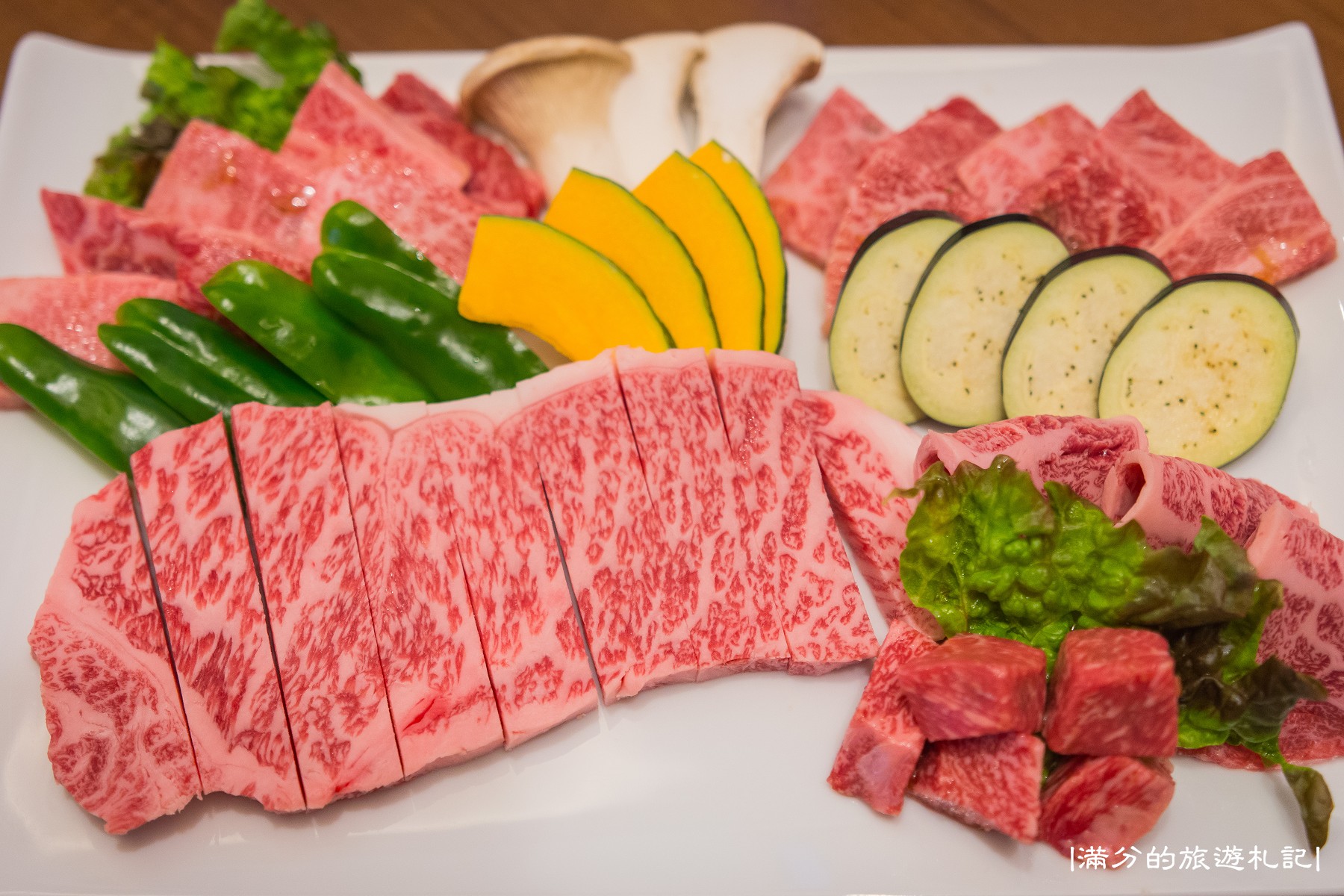
Hida Beef in Takayama: Where to Eat It by Style and Budget
Hida beef in Takayama: eight restaurants for steak, sukiyaki, yakiniku and hoba miso, with hours, closed days, prices and maps, and what makes it Hida beef.
Hirayu Waterfall Ice Festival 2027: Light-up, Buses, Stays
Hirayu Waterfall Ice Festival, 15 to 25 Feb 2027: the frozen falls lit 19:00 to 21:00, nightly fireworks, bus times, the last bus back and Hirayu Onsen stays.
Shin Hotaka Ropeway from Takayama: Fares, Bus, Tours (2026)
Shin Hotaka Ropeway from Takayama: ¥3,800 return, the ¥2,200 Nohi bus (no reservation), the passes that beat it, winter hours and the tours worth it.