Takayama Spring Festival 2027: Schedule, Floats, Stays
By Takayama Gifu Team · Updated · 10 min read
Map
- Hie Shrine (Hida Sanno-gu), 156 Shiroyama, Takayama, Gifu
The Takayama Spring Festival (Sanno Matsuri) is held on 14 and 15 April every year, whatever the weekday, and in 2027 that puts it on a Wednesday and a Thursday. The dates are set by Hie Shrine, whose annual festival it is, so there is nothing to wait for: book the room first, then plan the two days around the programme below. The hours are those of the 2026 programme published by the Takayama Festival Association (高山祭協賛会); the festival keeps the same timetable from year to year, and the 2027 programme, due in spring 2027, will confirm them. We will update this page and the events calendar when it appears.
2027 at a glance
| Dates | Wednesday 14 and Thursday 15 April 2027 (every year on 14 and 15 April) |
| Shrine | Hie Shrine (Hida Sanno-gu), 156 Shiroyama: the guardian shrine of the southern half of the old castle town |
| Floats | 12 yatai; Sanbaso, Shakkyo-tai and Ryujin-tai perform karakuri marionette shows |
| Karakuri | 10:00 to 10:50 and 14:00 to 14:50 on both days, at the Jinya-mae crossing (2026 times) |
| Procession (Gojunko) | 14 April 12:45 to 16:00; 15 April 12:30 to 15:30 (2026 times) |
| Night festival | 14 April only, 18:00 to 20:30 (2026 times) |
| Admission | Free, no tickets |
| Rain | Events are shortened or cancelled, never postponed |
| Festival information desk | 0577-32-7712, staffed on the two festival days only |
Two festivals, one UNESCO listing
“Takayama Festival” is the collective name for two shrine festivals. The spring one is the Sanno Matsuri of Hie Shrine, the guardian shrine of the southern half of the old castle town; the autumn one is the Hachiman Matsuri of Sakurayama Hachimangu, the northern half’s shrine, held on 9 and 10 October with eleven floats of its own. Each has its own floats, its own route and its own neighbourhood, so seeing one is not seeing the other.
The spring festival is the older of the two. A letter written in 1692 mentions a Sanno festival held once every three years, which the tourism association reads as evidence that the festival already existed around 1652; the floats came later, from about 1718. The floats were designated an Important Tangible Folk Cultural Property in 1960, the float events an Important Intangible Folk Cultural Property in 1979, and in 2016 UNESCO inscribed the Takayama Festival float events, together with 32 other Japanese festivals, as “Yama, Hoko, Yatai” on its Intangible Cultural Heritage list. For the city’s wider picture, start with our Takayama guide.
14 April, hour by hour
The times below are the 2026 programme. Expect the 2027 programme to match them to the minute, with the rain rule (below) as the only wildcard.
- 9:30 to about 15:00: the floats line up. Twelve floats are pulled out of their storehouses and displayed along Shinmei-cho street and the streets around it. Four of them, Kagura-tai, Sanbaso, Shakkyo-tai and Ryujin-tai, stand at the Jinya-mae crossing, the open space in front of Takayama Jinya at the west end of the Nakabashi bridge, where the festival’s otabisho (the temporary resting place of the shrine’s deity) is set up. The other eight are spread between Shinmei-cho and the old town’s upper streets.
- 10:00 to 10:50: the first karakuri performance. Sanbaso, Shakkyo-tai and Ryujin-tai perform their marionette shows one after another in front of the otabisho, each lasting about 20 minutes. The space in front of the otabisho is small, so be there well before 10:00 for a clear view.
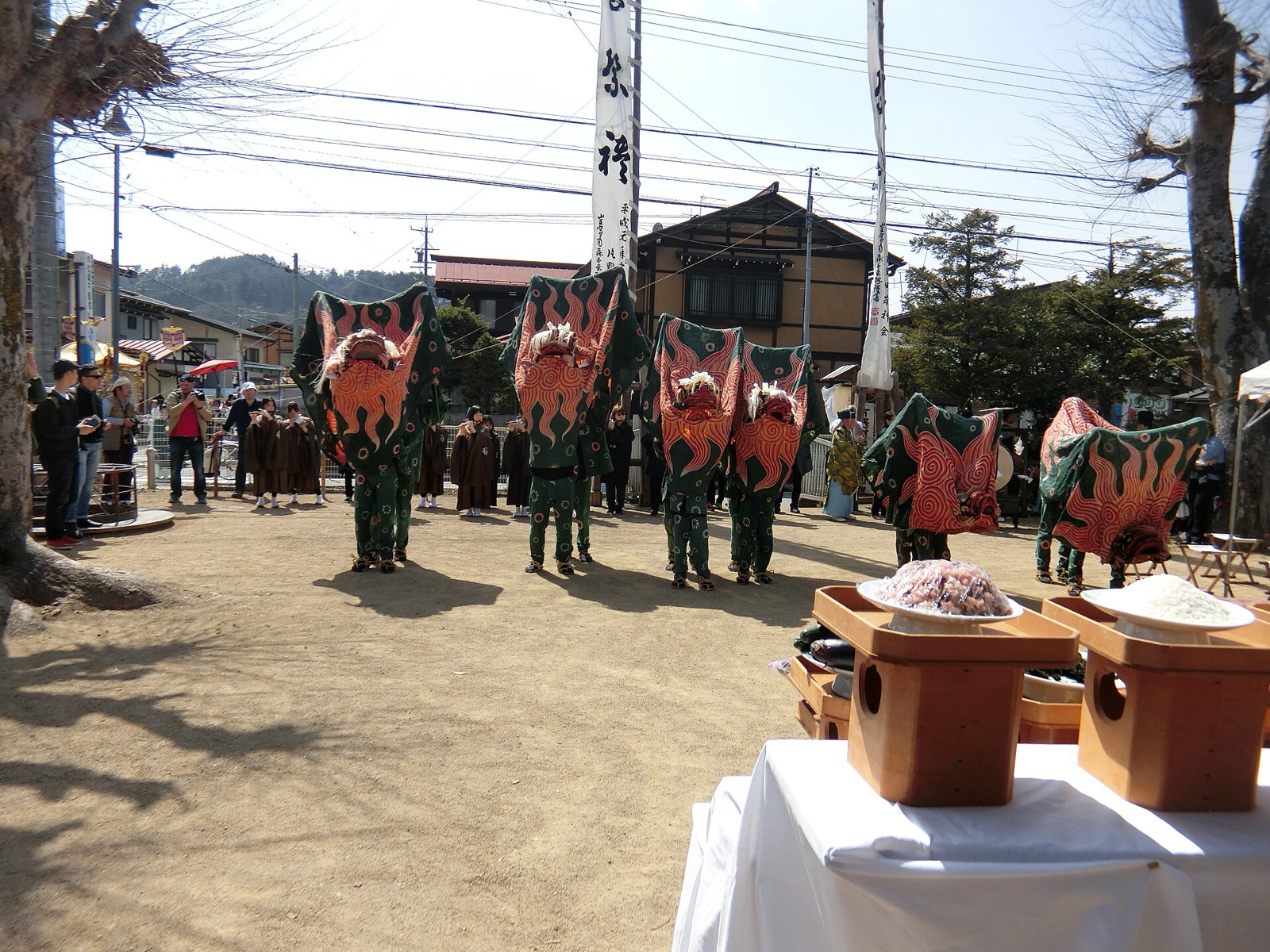
- 12:45 to 16:00: the Gojunko procession. A column several hundred strong winds through the festival district: lion dancers, gagaku musicians, tokeiraku performers (a Hida folk tradition) and guards in formal kamishimo dress. The hero photo above shows the festival’s shishimai lion dancers in their flame-patterned costumes.
- 14:00 to 14:50: the second karakuri performance, again at the otabisho. If you missed the morning show, this is the one to plan lunch around.
- 18:00 to 20:30: the night festival. Covered in its own section below.
15 April
The second day repeats the daytime programme without the night festival: floats on display from 9:30 to about 16:00, karakuri at 10:00 and 14:00, and the procession from 12:30 to 15:30. It is the quieter day, and in 2027 it falls on a Thursday, which should keep it quieter still. One caution: the official 2026 page records the 15 April procession as cancelled that year, with nothing rescheduled, which is exactly how the festival’s rain rule works. If the procession matters to you, be in town for the 14th.
The twelve floats and the three karakuri floats
The spring festival’s twelve yatai are Kagura-tai (神楽台), Sanbaso (三番叟), Kirin-tai (麒麟台), Shakkyo-tai (石橋台), Godaisan (五台山), Hoo-tai (鳳凰台), Ebisu-tai (恵比須台), Ryujin-tai (龍神台), Konko-tai (崑崗台), Kinko-tai (琴高台), Daikoku-tai (大国台) and Seiryu-tai (青龍台). Three of them, Sanbaso, Shakkyo-tai and Ryujin-tai, carry the karakuri marionettes. The rest are there to be looked at, and they reward it: multi-tiered bodies in black lacquer and gold leaf, carved panels, embroidered curtains and metal fittings, as the two photos below show.
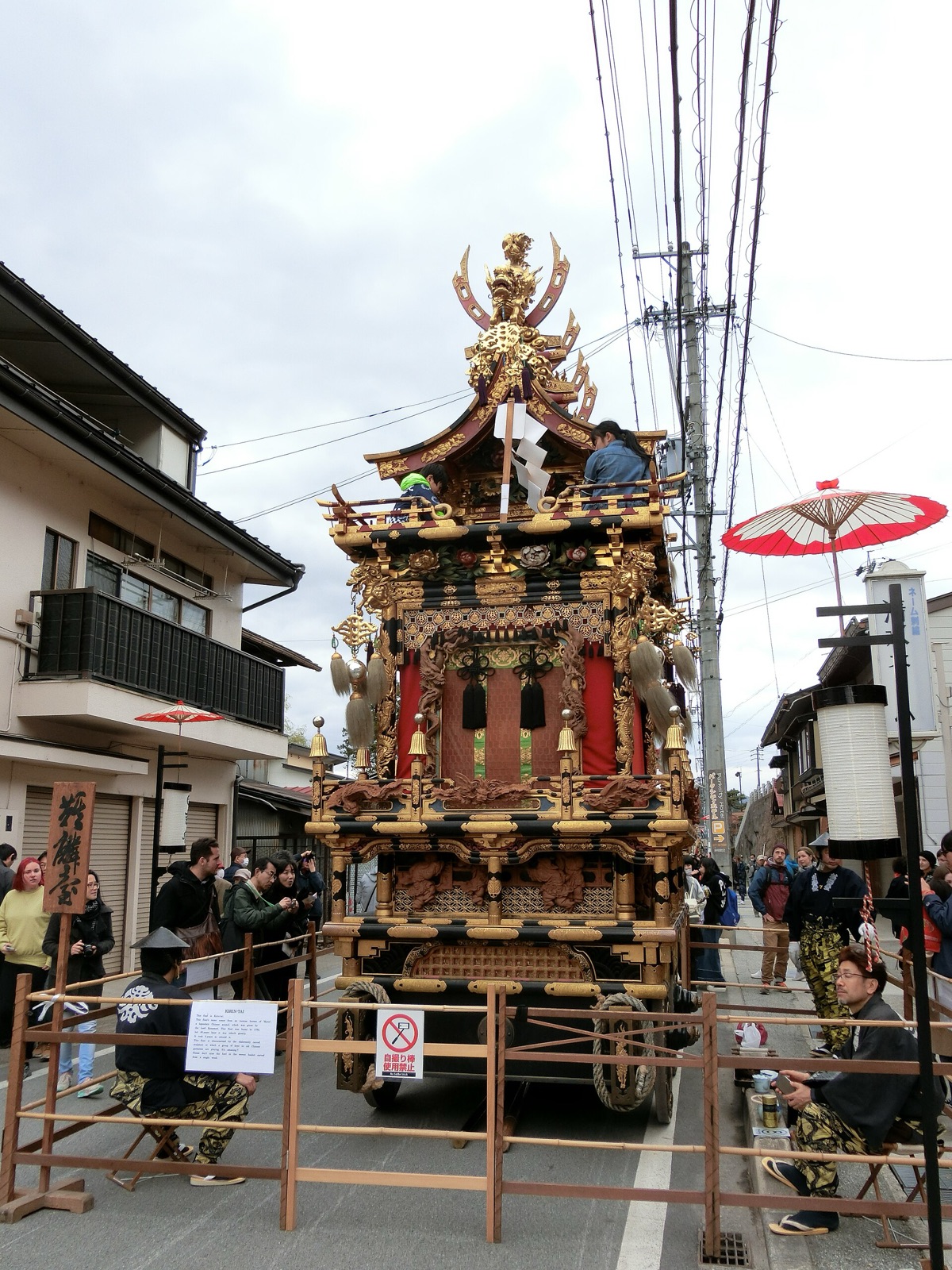
Kirin-tai on 14 April 2018. Photo: 大野 一将, CC BY-SA 4.0, via Wikimedia Commons.

Each float on display is roped off and attended by its own float association in festival dress; you can walk up to the barrier, and selfie sticks are banned there, as the sign in the 2018 photo above says.
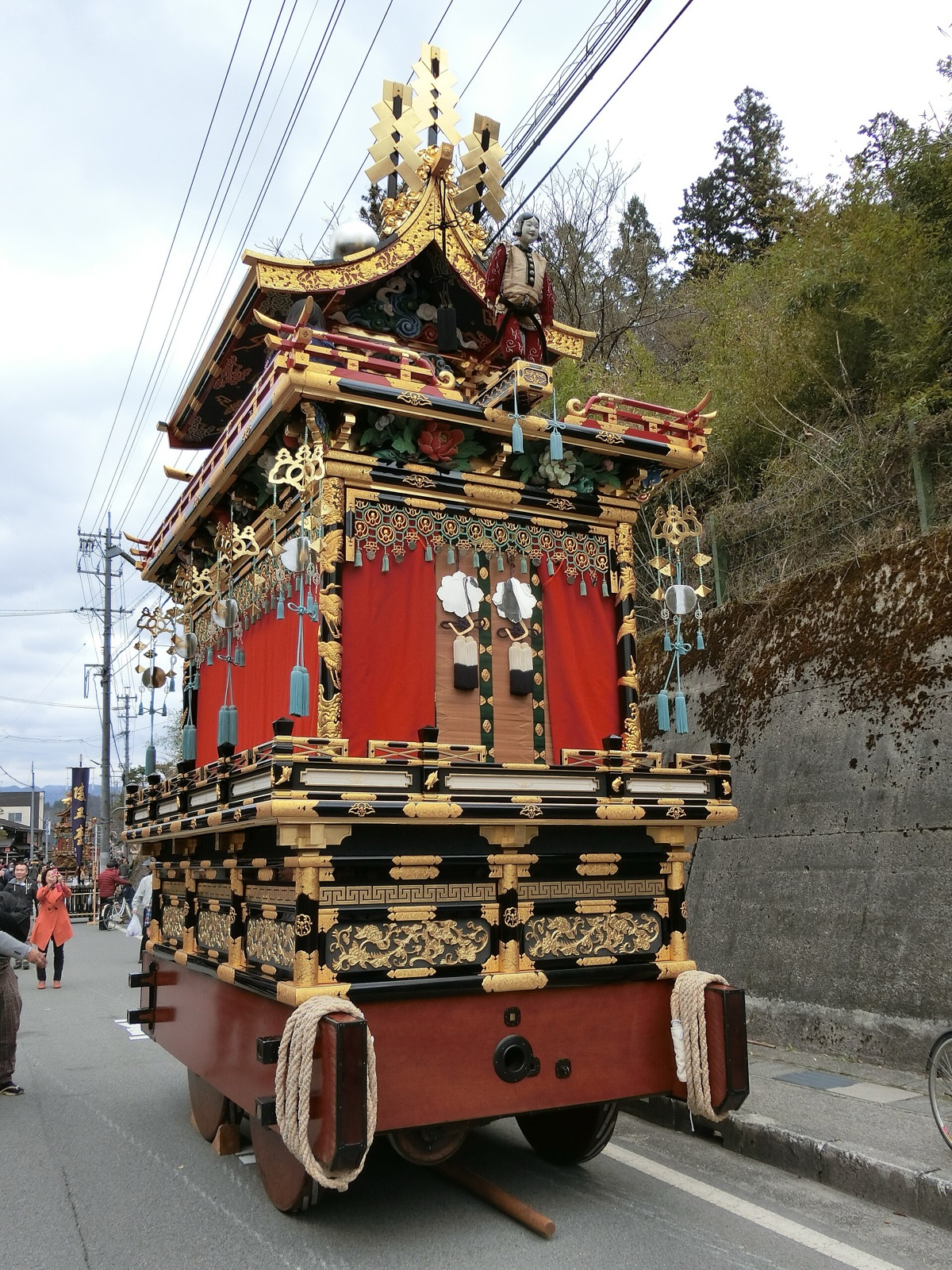
Konko-tai on 14 April 2018. Photo: 大野 一将, CC0 1.0, via Wikimedia Commons.

The night festival
On the evening of 14 April only, each float is hung with about 100 paper lanterns and pulled slowly through the town from 18:00 to 20:30, before each float returns to its own storehouse; the route is on the association’s programme. It is the only part of the festival that needs you to be in Takayama after dark. In 2027 that is a Wednesday night; check the last train on the getting-here page before you count on a day trip, and the safer plan is a bed in town.
Getting there and parking
By train and bus. The Limited Express Hida reaches Takayama from Nagoya in about 2 h 20 to 2 h 30 min, and highway buses from Tokyo, Osaka, Kyoto, Kanazawa and Matsumoto end at the bus centre beside the station; the getting-here page has every route with fares and the rail passes that cover them. The old town is a 15-minute walk from the station. On the two festival days the Nohi buses to Hirayu and Shin-Hotaka skip their old-town stop and run from the bus centre only, as our getting-around page explains; lockers and luggage forwarding are on the luggage page.
By car. The streets around the floats are closed to traffic on both days under a regulation map the association publishes with the programme. The association’s parking advice for 2026 was:
- a free temporary car park at Takumigaoka (匠ヶ丘町221付近), with a free shuttle bus to the Takayama Citizens’ Cultural Hall (高山市民文化会館) every 20 to 30 minutes depending on traffic, a 15 to 20 minute ride, running 9:00 to 21:00 on the 14th and 9:00 to 16:00 on the 15th;
- paid temporary lots at the former police station and former Legal Affairs Bureau sites, ¥1,000 per car, plus the eight city car parks;
- for coaches, a dedicated lot at the Shinko headquarters (眞光本部), ¥3,000 for a full-size coach and ¥2,000 for a microbus, with the same free shuttle to the Cultural Hall.
The Cultural Hall is on the west side of town, a walk from the old town, so leave plenty of time from parking to the first karakuri show.
Where to stay, and how early
The city’s own statistics show why rooms are the first thing to book: April 2025 brought 107,423 foreign overnight stays to Takayama, the second-highest month of the year, and the festival sits in the middle of it. A midweek edition like 2027’s takes a little pressure off, but the old town’s ryokan are small and fill early. Book now, and keep the cancellation terms flexible in case the 2027 programme surprises you. Our stay hub sorts the options by area; for a live search, try Takayama on Agoda or Takayama on Booking.com.
If the town is full, Hida-Furukawa is one stop north on the Hida or 30 to 35 minutes on the Nohi bus (¥380), and Gero Onsen is on the same line to the south; both let you be back for the morning karakuri and still see the lanterns.
If it rains
The rule is printed on the programme every year: in rain, each event is reduced or cancelled, and nothing is moved to another day. The programme names each float’s storehouse as the display point, and the storehouses as the karakuri venue, for when the streets are rained off. Admission is free, so there is nothing to refund, but it is one more reason to plan for both days rather than one.
Watching from home
The association’s 2026 page says the karakuri performances were streamed live on YouTube. It is no substitute, but it is a way to see the 2027 programme in action before you commit to 2028.
Book the trip
- The room. Takayama on Agoda or Takayama on Booking.com, 14 to 15 April 2027, before anything else.
- The rail pass. If you are coming from Nagoya, Kanazawa, Toyama, Kyoto or Osaka, the Takayama-Hokuriku Area Tourist Pass (¥19,800 for five days) covers the Hida and the Shirakawa-go bus: buy it on Klook. The sums are on the getting-here page.
- The days around it. Shirakawa-go and the Okuhida onsen villages are the natural add-ons; the tours hub lists what starts from Takayama.
FAQ
Are the Takayama Spring Festival dates the same every year? Yes: 14 and 15 April, fixed by Hie Shrine. In 2027 they fall on a Wednesday and a Thursday.
Which day should I choose if I only have one? 14 April, because it has the night festival and both karakuri shows. The 15th has the daytime programme only.
Does it cost anything? No. There are no tickets, grandstands or reserved areas; you stand where you can.
What time should I arrive for the karakuri? Well before 10:00 for the first show and before 14:00 for the second; the space in front of the otabisho is small and each show lasts only about 20 minutes.
Will the cherry blossoms be out? We don’t forecast bloom dates. Check the association’s bloom reports in the weeks before you travel.
Spring or autumn? Spring has twelve floats, three karakuri floats and a single night festival on the 14th; autumn, on 9 and 10 October, has eleven floats and its evening parade on the 9th. Both are free, both are UNESCO-listed, and the city’s figures show October as the busier month from abroad.
Can I do it as a day trip from Nagoya? The daytime programme, yes, if the morning Hida times on the getting-here page suit you. The night festival ends at 20:30, after which you need a bed in Takayama, Hida-Furukawa or Gero.
Sources
Checked on 4 November 2026.
- Hida Takayama Tourism Association, 春の高山祭(山王祭) (dates rule “毎年4月14日・15日に開催”, history, shrine, floats, karakuri, cultural-property and UNESCO designations): hidatakayama.or.jp; 2026年春の高山祭 (the 2026 programme: float display, karakuri, procession and night festival times, the four floats at the crossing, the rain rule “各行事は縮小または中止となります。その場合、別日に延期することはありません。”, shuttle buses, parking and fees, the 0577-32-7712 desk, the YouTube stream, the 15 April 2026 procession cancellation): hidatakayama.or.jp; the 2026 programme PDF by 高山祭協賛会: hidatakayama.or.jp (PDF); autumn festival: hidatakayama.or.jp
- Gifu Prefecture tourism, 春の高山祭 2026 (times, Takumigaoka shuttle): kankou-gifu.jp
- Takayama City, 令和7年 高山市外国人観光客宿泊統計 (April 2025 foreign stays): city.takayama.lg.jp (PDF)
- Hie Shrine (address): hiejinja.com
- Train, bus and fare figures as checked on our getting-here and getting-around pages
- Map coordinates: Hie Shrine from Japanese Wikipedia; the Cultural Hall from Japanese Wikipedia (高山市民文化会館); Takumigaoka-cho, the Shinko headquarters address and Honmachi 1-chome from the GSI address search; Nakabashi from OpenStreetMap
Photos
Hero: shishimai lion dancers at the Takayama Spring Festival, 14 April 2017. Photo: 大野 一将, CC BY-SA 4.0, via Wikimedia Commons. Body photos credited under each image.
