Takayama Autumn Festival 2027: 9 to 10 October Schedule, Floats, Stays
By Takayama Gifu Team · Updated · 13 min read
Map
- Sakurayama Hachimangu, 178 Sakuramachi, Takayama, Gifu
The Takayama Autumn Festival (Hachiman Matsuri) is held on 9 and 10 October every year, whatever the weekday, and in 2027 that puts it on a Saturday and a Sunday. The dates belong to Sakurayama Hachimangu, whose annual festival it is, and have been fixed since 1968, so there is nothing to wait for: a weekend edition will fill the town’s small ryokan and the Hida trains earlier than usual, and the room is the first thing to book. The hours below are the 2026 programme published by the Hida Takayama tourism association; the festival keeps the same timetable from year to year, and the 2027 programme, due in autumn 2027, will confirm them. We will update this page and the events calendar when it appears.
2027 at a glance
| Dates | Saturday 9 and Sunday 10 October 2027 (every year on 9 and 10 October) |
| Shrine | Sakurayama Hachimangu, 178 Sakuramachi: the guardian shrine of the northern half of the old castle town |
| Floats | 11 yatai, lined up on the shrine’s approach; Hotei-tai performs the karakuri in the shrine grounds |
| Karakuri | 9 October 12:00 and 14:00; 10 October 11:00 and 13:00; about 20 minutes each (2026 times) |
| Procession (Goshinko) | 9 October 13:20 to 15:30; 10 October 8:30 to 12:00 and 13:30 to 16:00 (2026 times) |
| Float pulling (Hikimawashi) | 9 October only, 13:30 to 15:30, four floats (2026 times) |
| Lantern parade (Yoimatsuri) | 9 October only, 18:00 to about 21:30 (2026 times) |
| Admission | Free, no tickets |
| Rain | Events are shortened or cancelled, never postponed; the karakuri moves indoors to the Sakurayama Nikko-kan |
| Festival information desk | A dedicated line opened for the two days only; 2026’s was 0577-34-1153, and the number changes each year |
The northern half’s festival
“Takayama Festival” is two shrine festivals. The spring festival is the Sanno Matsuri of Hie Shrine, the guardian shrine of the southern half of the old castle town, on 14 and 15 April. The autumn one is the Hachiman Matsuri of Sakurayama Hachimangu, the shrine of the northern half: eleven floats of its own, a route of its own and a programme that differs from spring in three ways. The floats stand together on the shrine’s approach instead of across the town, four of them are pulled through the streets on the afternoon of the 9th (spring never does this), and the procession carries the deity on a two-day journey with an overnight stop at the otabisho.
The tourism association traces the festival’s origin to the Kanamori era, the clan that ruled Hida from 1585 to 1692, and the floats to about 1718. The eleven autumn floats, with the twelve spring ones, were designated an Important Tangible Folk Cultural Property in 1960; the float events became an Important Intangible Folk Cultural Property in 1979, and in 2016 UNESCO inscribed the Takayama Festival float events, together with 32 other Japanese festivals, as “Yama, Hoko, Yatai” on its Intangible Cultural Heritage list. For the wider picture of the city, start with our Takayama guide.
9 October, hour by hour
The times are the 2026 programme and are given as “about” on the official map; expect 2027 to match them, with the weather rule (below) as the only wildcard.
- 9:00 to about 17:00: the floats line up. The yatai are pulled out of their storehouses and stand along the shrine’s approach (omotesando), Hotei-tai in the grounds themselves. You can walk the line and study each one from the barrier. In 2026 only ten were shown, because Gyojin-tai was under repair; the 2027 programme will say whether it is back.
- 12:00 to about 12:20: the first karakuri performance, by Hotei-tai in the shrine grounds. The grounds are not large and this is the autumn festival’s only karakuri, so be there well before noon.
- 13:20 to about 15:30: the Goshinko procession. The deity’s palanquin leaves the shrine with a column several hundred strong: lion dancers, tokeiraku percussion (a Hida tradition), gagaku musicians and guards in formal kamishimo dress, through the streets of the northern parishes to the otabisho, the deity’s temporary resting place, where it stays the night.
- 13:30 to about 15:30: the Hikimawashi float pulling. Four floats, including Kagura-tai and Hoo-tai, leave the approach and are pulled on a loop through the Oshinmachi streets north of the shrine. The association calls it the autumn festival’s special event: it is the one time you see the floats move in daylight, wheels, steering and all.
- 14:00 to about 14:20: the second karakuri performance, again in the grounds.
- 18:00 to about 21:30: the Yoimatsuri lantern parade. Covered in its own section below.
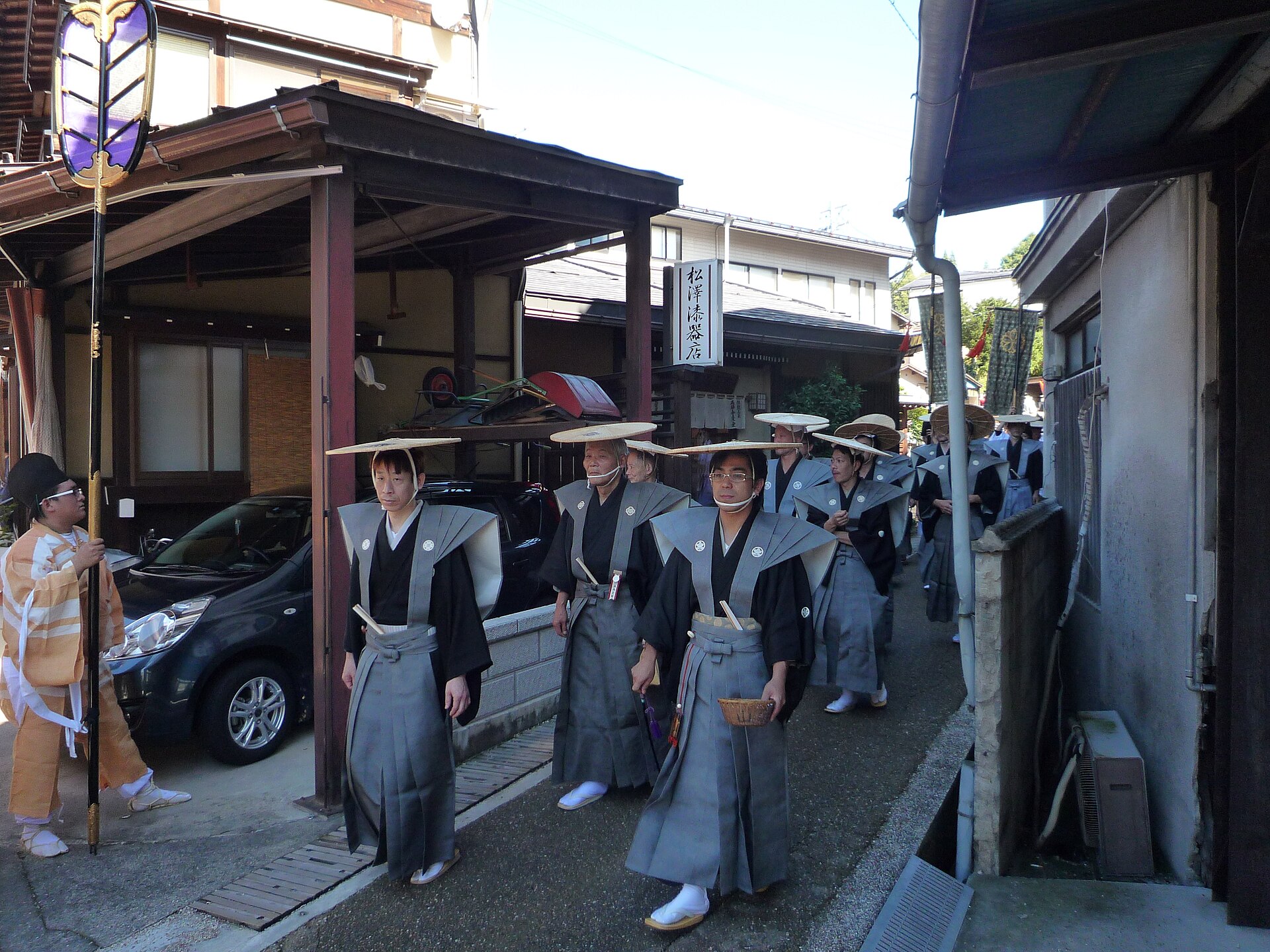
Guards in the Goshinko procession, 10 October 2013. Photo: Sjaak Kempe from Groningen, The Netherlands, CC BY 2.0, via Wikimedia Commons.

10 October
The second day is the deity’s journey home. The procession goes out again from 8:30 to about 12:00, passing Oshinmachi 5-chome around 9:30, then leaves the otabisho at 13:30 and works its way back along Yasukawa-dori (the 2026 map gives passing times of 13:40, 14:30, 15:10 and 15:40 at points along the street) to arrive at the shrine approach around 16:00. The floats are on show from 9:00 to about 16:00, the karakuri plays at 11:00 and 13:00, and at dusk the floats are pulled back to their storehouses. There is no evening parade, so a day trip works on the 10th in a way it does not on the 9th. In 2027 it is a Sunday, and the 9th a Saturday: plan on crowds both days, and on the 9th into the night.
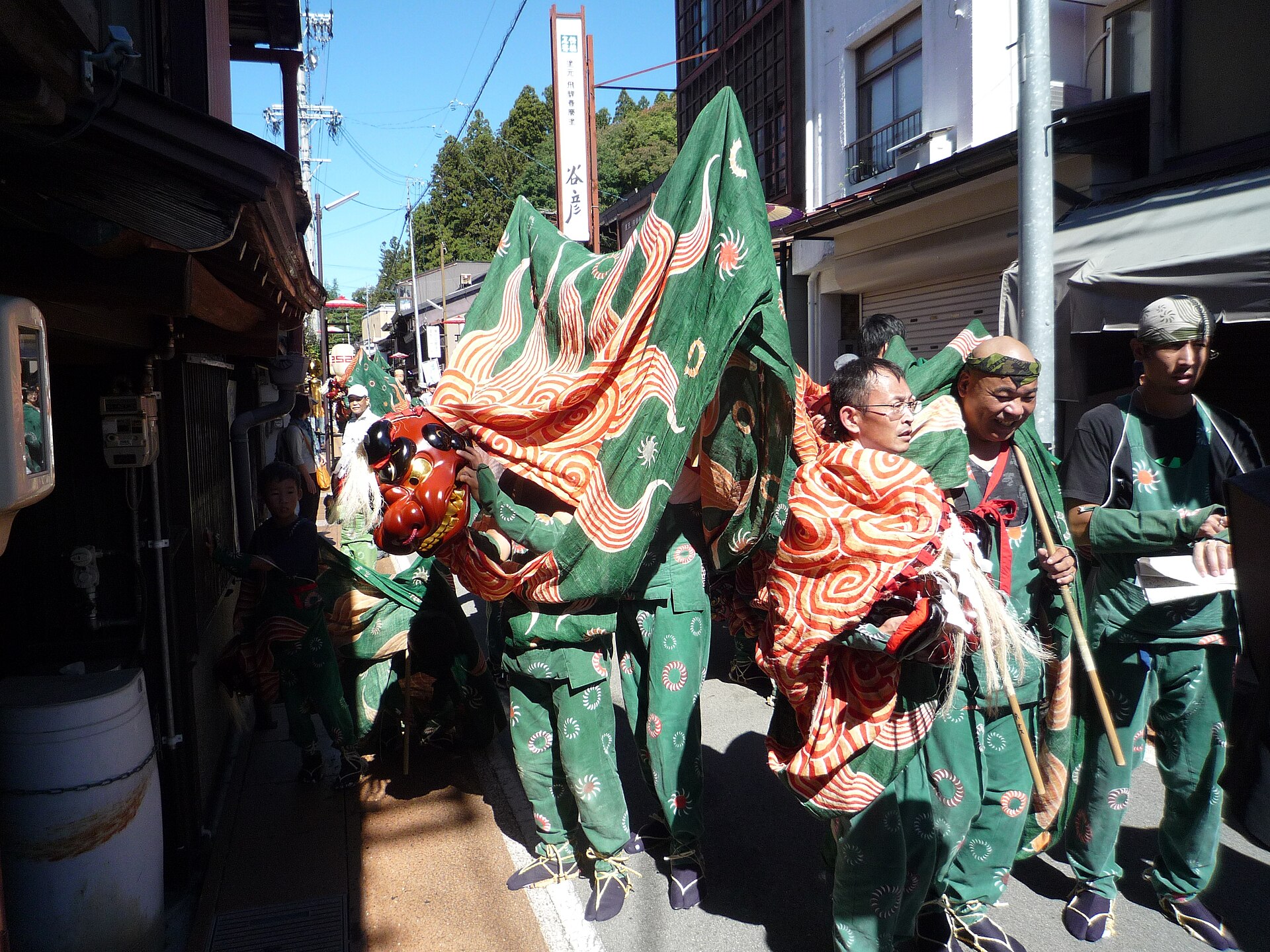
Shishimai lion dancers in the procession, 10 October 2013. Photo: Sjaak Kempe from Groningen, The Netherlands, CC BY 2.0, via Wikimedia Commons.

The eleven floats and Hotei-tai’s karakuri
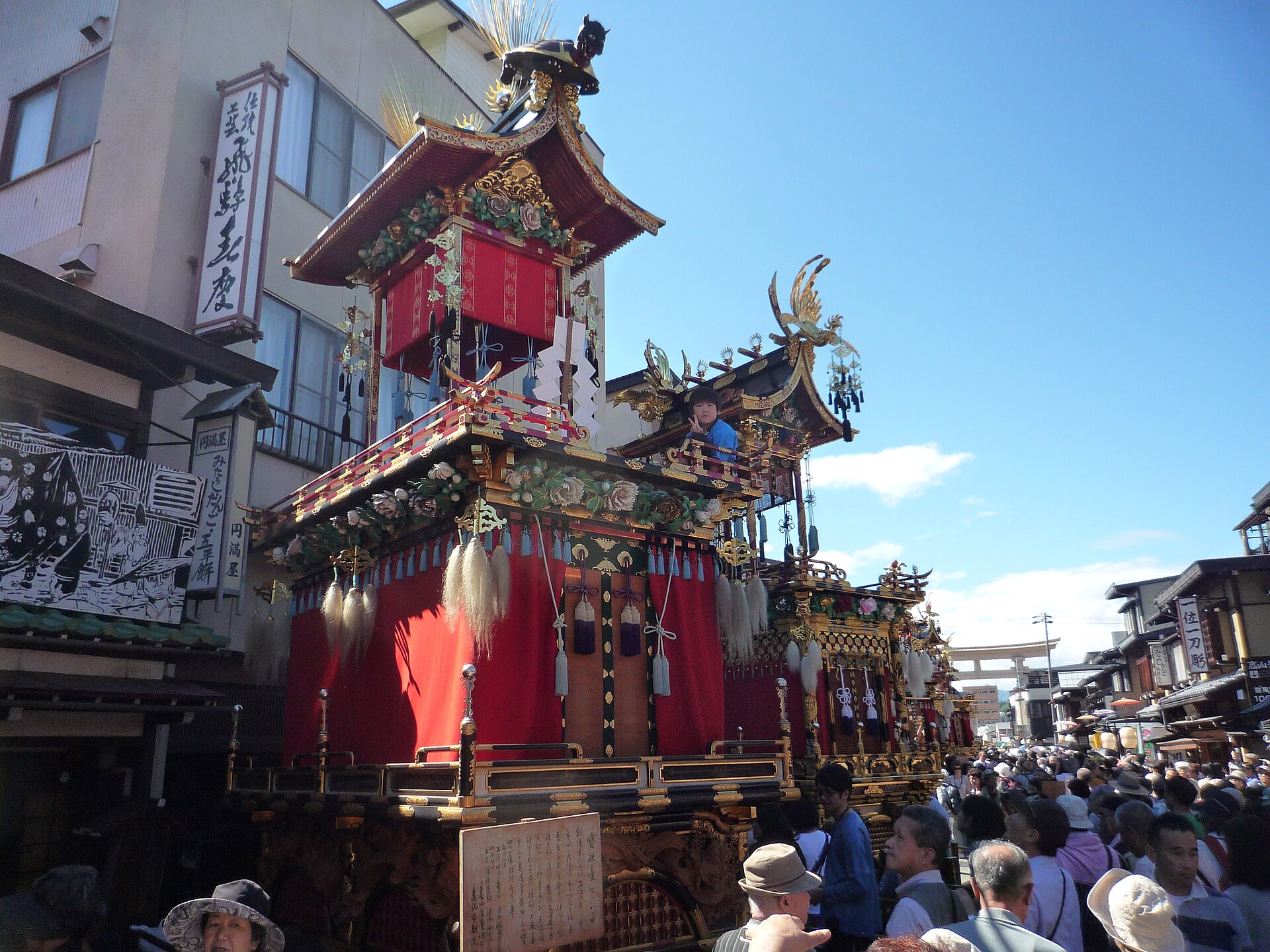
The autumn yatai are Kagura-tai (神楽台), Hotei-tai (布袋台), Kinpo-tai (金鳳台), Daihachi-tai (大八台), Kyuho-sha (鳩峯車), Jinma-tai (神馬台), Sennin-tai (仙人台), Gyojin-tai (行神台), Hoju-tai (宝珠台), Homei-tai (豊明台) and Hoo-tai (鳳凰台). The association’s 2026 leaflet gives each its signature: Kagura-tai’s great drum and golden phoenix, Daihachi-tai’s black-lacquered court carriage, Kyuho-sha’s tapestry panels on all four sides, Jinma-tai’s white horse and white-robed doll, Sennin-tai’s painted sword-wrapped dragons at the ridge ends, Hoju-tai’s pair of great turtles on the roof, Homei-tai’s great phoenix and lion-and-peony carvings, and Hoo-tai’s “lion crossing the valley” carving by the Hida master Taniguchi Yoshika and his pupil Asai Kazuyuki. The hero photo above shows one of them standing in the crowd with its white tassels and gilded crest.
Hotei-tai is the one that performs. To the tune “Rokudan-kuzushi”, two karakuri children, a boy and a girl, swing in turn across five trapeze bars and leap onto the shoulders and hands of the god Hotei; when they land, a banner reading 和光同塵 (wako dojin) unfurls from the fan in Hotei’s left hand. Eight puppeteers work 36 strings from inside the float, unseen. Each show lasts about 20 minutes, twice a day on both days, in the shrine grounds, and that is the whole of the autumn festival’s karakuri, so plan your day around one of the four slots.
The Yoimatsuri route
Late on the afternoon of the 9th, the floats go back from the approach to their storehouses, where each is hung with about 100 paper lanterns. At 18:00, led by Kagura-tai, the whole set (eleven in a normal year, ten in 2026) begins to move through the night streets. The 2026 route ran from Oshinmachi down Shimo-Ninomachi, along Yasukawa-dori and back up Shimo-Ichinomachi; on Yasukawa-dori the floats lined up head-first from 19:00 and pulled out again around 20:10, which is the moment to be standing there. The parade winds down by about 21:30, each float singing the parting song “Takai Yama” as it returns to its own storehouse. Streets on the route are closed to traffic from 18:00 to 22:00. It is the only part of the festival that needs you in Takayama after dark, and in 2027 that is a Saturday night, so a bed in town, booked early, is the plan.
The Yatai Kaikan on the shrine grounds
Outside the two festival days, the autumn floats live in the Takayama Matsuri Yatai Kaikan on the shrine grounds, which shows four of the eleven at a time and rotates them three times a year. The attached Sakurayama Nikko-kan holds a one-tenth scale model of Nikko Toshogu, built in the Taisho era by 33 craftsmen over fifteen years; it is also where the karakuri performance moves when rain stops it in the grounds. Japanese Wikipedia lists the hall as open daily, 9:00 to 17:00 (to 16:30 from December to February), with one ¥1,000 adult ticket covering both halls; the shrine’s own site has the current hours. The festival information desk is set up by the car park below the Nikko-kan.
Getting there and parking
By train and bus. The Limited Express Hida reaches Takayama from Nagoya in about 2 h 20 to 2 h 30 min, and highway buses from Tokyo, Osaka, Kyoto, Kanazawa and Matsumoto end at the bus centre beside the station; the getting-here page has every route with fares and the rail passes that cover them, and warns that trains around the October festival fill early, so reserve seats as soon as the booking window opens. Sakurayama Hachimangu is about 20 minutes on foot from the station, through the old town and north along the Miyagawa. On festival days the Nohi buses to Hirayu and Shin-Hotaka skip their old-town stop and run from the bus centre only (in 2026 from 9 to 12 October), as our getting-around page explains; lockers and luggage forwarding are on the luggage page.
By car. The streets around the shrine and its approach are closed to traffic from 6:30 on both days (until 22:00 on the 9th and 17:00 on the 10th in 2026), and the Yoimatsuri streets from 18:00 to 22:00 on the 9th. The association’s 2026 parking advice was:
- a free temporary car park at Takumigaoka (匠ヶ丘町221付近), open 8:30 to 21:00 on the 9th and 8:30 to 16:00 on the 10th, with a free shuttle to the Takayama Citizens’ Cultural Hall (高山市民文化会館) every 15 to 20 minutes, a 15 to 20 minute ride, running 9:00 to 21:00 on the 9th and 9:00 to 16:00 on the 10th;
- a paid temporary lot at the former police station site, ¥1,000 per car, opened only once the regular car parks are full, plus nine city car parks at ¥150 per 30 minutes by day and ¥50 an hour at night;
- for coaches, the dedicated lot at the Shinko headquarters (眞光本部), ¥3,000 for a full-size coach and ¥2,000 for a microbus, with the same free shuttle, and the Takayama Betsuin car park at ¥3,000 per two hours.
The Cultural Hall is on the west side of town, across the Miyagawa from the shrine, so leave plenty of time between parking and the first karakuri.
Where to stay, and how early
The city’s own statistics make the case: October 2025 brought 112,775 foreign overnight stays to Takayama, the highest month of the year, ahead of April’s 107,423, and the festival sits at the start of it. A Saturday-Sunday edition like 2027’s adds domestic weekend traffic on top. The ryokan of the old town and the northern parishes are small and fill first; book now, with cancellation terms flexible enough to adjust once the 2027 programme is out. Our stay hub sorts the options by area; for a live search, try Takayama on Agoda or Takayama on Booking.com.
If the town is full, Hida-Furukawa is one stop north on the Hida or 30 to 35 minutes on the Nohi bus (¥380), and Gero Onsen is on the same line to the south; both get you back for the morning floats, and the last trains after the lantern parade are on the getting-here page.
If it rains
The rule is printed on the programme every year: in bad weather each event is reduced or cancelled, and nothing is moved to another day. The autumn festival has one advantage over spring here: the karakuri has a roof to retreat to, the Sakurayama Nikko-kan, so the puppets perform even when the grounds are rained off. Admission is free, so there is nothing to refund, but it is one more reason to be in town for both days rather than one.
Watching from home
The association streams the festival on its YouTube channel; the 2026 page links the live streams. It is no substitute, but it is a way to see the Hotei-tai karakuri before you commit to 2027, or to catch the lantern parade if rain takes it away.
Book the trip
- The room. Takayama on Agoda or Takayama on Booking.com, 9 to 10 October 2027, before anything else: it is a weekend.
- The rail pass. If you are coming from Nagoya, Kanazawa, Toyama, Kyoto or Osaka, the Takayama-Hokuriku Area Tourist Pass (¥19,800 for five days) covers the Hida and the Shirakawa-go bus: buy it on Klook. The sums are on the getting-here page.
- The days around it. Early October is also the start of the autumn colours in Okuhida; the tours hub lists what starts from Takayama, and the spring festival page is the comparison if you are choosing between the two.
FAQ
Are the Takayama Autumn Festival dates the same every year? Yes: 9 and 10 October, fixed by Sakurayama Hachimangu since 1968. In 2027 they fall on a Saturday and a Sunday.
Which day should I choose if I only have one? 9 October: it has the float pulling, two karakuri shows and the lantern parade. The 10th has the procession’s return and two karakuri shows, and ends at dusk.
Does it cost anything? No. There are no tickets, grandstands or reserved areas. The Yatai Kaikan on the shrine grounds charges admission, but it is a museum, not the festival.
Where exactly is the karakuri? In the grounds of Sakurayama Hachimangu, by Hotei-tai, twice a day; in rain, inside the Sakurayama Nikko-kan next to the approach.
Spring or autumn? Spring has twelve floats and three karakuri floats; autumn has eleven floats, one karakuri float with the most elaborate act, and the daytime float pulling that spring lacks. Both are free and both are UNESCO-listed. The city’s figures show October as the busier month from abroad.
Can I do it as a day trip from Nagoya? The 10th, yes. The 9th ends with the lantern parade at about 21:30, after which you need a bed in Takayama, Hida-Furukawa or Gero.
Sources
Checked on 4 November 2026.
- Hida Takayama Tourism Association, 秋の高山祭(八幡祭) (dates “毎年10月9日、10日に開催”, fixed in 1968: “昭和43年にこの日程に定められました”, origin in the Kanamori era, floats from about 1718, the eleven floats, the Hotei-tai karakuri: “六段崩し”, two karakuri children, five 綾, 和光同塵 banner, 36 strings and 8 puppeteers, the four-float 曳き廻し including 神楽台 and 鳳凰台, the Yoimatsuri from 18:00 led by 神楽台 with about 100 lanterns per float, the two-day Goshinko, cultural-property and UNESCO designations): hidatakayama.or.jp; 2026年秋の高山祭 (the 2026 programme: float display, karakuri, Goshinko and Yoimatsuri times and route, the note “行神台修理中のため屋台は10台のみ”, the rain rule “各行事は縮小または中止となります。その場合、別日に延期することはありません。からくり奉納は桜山日光館にて行います。”, parking lots, fees and hours, the shuttle, the 0577-34-1153 desk by the Nikko-kan car park, the YouTube streams): hidatakayama.or.jp; the 2026 programme and traffic-regulation map PDF (Hikimawashi 13:30 to 15:30, Yasukawa-dori 頭出し 19:00 and 曳き出し 20:10, the 10 October passing times, road closure hours, shuttle hours): hidatakayama.or.jp (PDF); the 2026 festival leaflet (Hotei-tai in the grounds and the other ten on the approach, the parting song 高い山, each float’s signature feature, the yearly change of the festival phone line): hidatakayama.or.jp (PDF)
- Takayama City, 令和7年 高山市外国人観光客宿泊統計 (October and April 2025 foreign overnight stays): city.takayama.lg.jp (PDF)
- Japanese Wikipedia, 櫻山八幡宮 (address, coordinates) and 高山祭屋台会館 (four of eleven floats shown, three rotations a year, the Nikko Toshogu model, hours and admission): ja.wikipedia.org, ja.wikipedia.org
- Train, bus and fare figures, and the festival-day bus detour, as checked on our getting-here and getting-around pages
- Map coordinates: Sakurayama Hachimangu from Japanese Wikipedia; the Nikko-kan and Shimo-Ninomachi from OpenStreetMap; Takumigaoka-cho from the GSI address search; the Cultural Hall from Japanese Wikipedia
Photos
Hero: a festival float in the old-town crowd at the Takayama Autumn Festival, 10 October 2013. Photo: Sjaak Kempe from Groningen, The Netherlands, CC BY 2.0, via Wikimedia Commons. Body photos credited under each image.
